Courageous Confidence: The Leadership Skill Hiding Behind Your Niceness

Here's a question worth pondering today. What would it look like if you led with more confidence, right now, in the role you're currently in?
We ask leaders this all the time, and the pause that follows is revealing. Most people can picture it. Most people also aren't doing it.
Here's what we notice, in coaching calls, in team meetings, in the entrepreneurial companies we work with every day. Leaders have good ideas, real perspective, and hard-won knowledge of their role. Yet when the share their perspective and ideas once, and it doesn't land the way they hoped, they quietly pull it back. "Well, I put it out there. They didn't really hear me. Moving on."
That's not confident leadership. It’s niceness.
Niceness is costing you more than you think
We coach strongly on considering the whole person. Emotions matter. People are not machines, and good leadership never pretends otherwise. But there's a version of "considering the whole person" that has quietly turned into over-responsibility for how everyone else feels, all the time.
If someone reacts to your decision with frustration, that's their process. It is not your job to manage it for them. If you soften a hard truth so much that the real message disappears, you haven't been kind. You've been unclear, and unclear is not a kindness to anyone.
The business needs leaders who can be courageously confident. Not loud. Not aggressive. Confident. Grounded in the clarity of their own perspective from their expertise in their role, willing to own it, willing to stand behind it even when the room doesn't immediately agree.
The message sent has to be the message received
This is one of the most practical shifts you can make starting today. It is not enough to say your idea once and hope it lands. Courageous confidence means making sure the person on the other side actually has what they need to fully consider your thinking.
Here's how, here's why it matters, here's what I expect will happen if we go this direction, let's talk it through. That's the version of confidence that respects both you and the decision-maker across from you. And here's the part that sets leaders free: once you've done that, once you've genuinely made sure your message was received, the outcome is no longer only on your shoulders. They may still go a different direction. There may be other factors to consider that they can share with you. In this, you did your part courageously and confidently.
That's a very different experience than whispering your thoughts into a busy meeting and quietly deciding you tried.
Self-protection versus self-leadership
When a result disappoints you, when a plan doesn't go the way you hoped, your nervous system has an automatic move: to protect you. That shows an urgency to fix everything immediately, as taking care of everyone's feelings, it shuts down the ability to look at what actually happened.
That's self-protection, and it will not produce your best thinking. Your prefrontal cortex, the part of your brain responsible for grounded, strategic decisions, goes offline exactly when you need it most.
Self-leadership is the alternative. It sounds like, "Here's what we prepped, here's the action we took, here's the result we got. Let's look at this together." It's clearer. And it's the only place your best business decisions can come forward.
The pause is your first move, not your last resort
One of the simplest and most underused tools here is the pause. Before you respond to a disappointing result. Before you comfort someone who's upset. Before you fix it. Pause. Give yourself, and everyone in the room, the dignity of processing before reacting.
You don't need to solve everything in the immediate moment. "Let's take a break and come back to this in an hour" is a positive and empowering leadership move.
Complete the cycle, don't over-triage it
Prep, action, result. That's the formula, and there's a temptation, when the result underwhelms, to throw every ounce of energy at fixing it right now. Sometimes that's right. Often it's over-triage, and it will exhaust you and your team for a return that doesn't justify the cost.
Try this instead. Stabilize what genuinely needs stabilizing. Then pause. Center to Self-Leadership. Come back together once everyone has their best thinking available, and use what you learned in the situation to inform what's next. That's completing the cycle, and it's how good teams actually get sharper instead of overwhelmed.
Your invitation this week
Observe yourself. Notice when you're taking care of someone else's emotions instead of being courageously confident in your own perspective and contribution. Notice when you're chasing a fantasy of how things were "supposed" to go instead of engaging with what's actually happened. Notice when you pull back an idea because it didn't land the first time.
Courageous confidence is simply this: owning your perspective, using your voice fully, and trusting that your perspective matters enough to contribute with confidence.
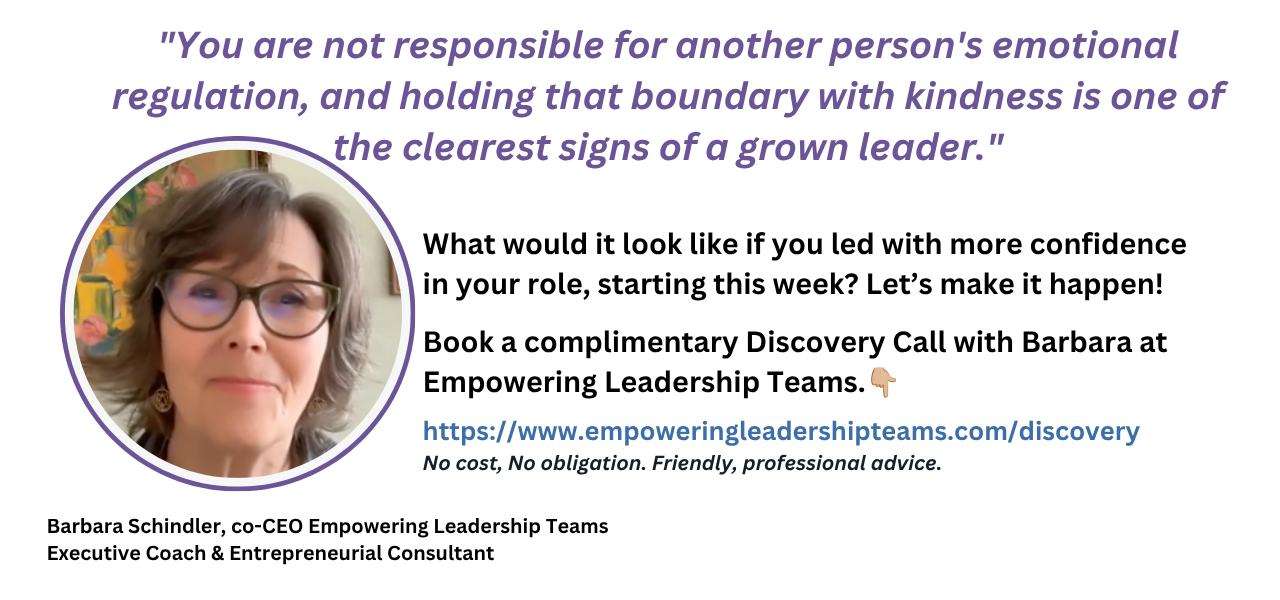
What would it look like if you led with more confidence this week? We'd genuinely like to know. And if you want support building that muscle in yourself or across your team, Heather and Barbara offer a complimentary discovery call. Book yours below.
Related Video:
Why Being "Too Nice" Is Quietly Weakening Your Leadership
Related Articles:
Intentional Leadership: How Purpose-Driven Behavior Builds High-Performance Teams
The Science of Authentic Leadership: Why Integrity Builds Measurable Credibility