"Yes, And": The Leadership Communication Shift That Protects Your Team and Your Results

Let me ask you something.
When was the last time someone on your team brought you a brilliant, exciting, terrible-timed idea—and you had to figure out what to do with it?
Maybe it was right before a major launch. Maybe it was mid-project, when the team was already stretched. Maybe it came from an outside consultant or a mastermind your CEO is part of, and now there's pressure to pivot.
Whatever the scenario, you know the feeling. There's a flash of "oh no." A quick calculation of what it would take to implement. And then the very human, very understandable urge to say: No.
Here's the problem. That "no"—even when it's absolutely the right call—can quietly erode your team's trust, creativity, and willingness to bring you their thinking in the future. And that cost, compounded over months and years, is enormous.
But what if there were a better way? Not a way to say yes to everything. Not toxic positivity or endless meetings to evaluate every idea. A real, practical, repeatable way to navigate those moments with confidence, clarity, and collaboration built in.
That's what we cover in Episode #9 of Leadership With a Twist—and it starts with two small words: "Yes, And."
The Improv Principle That Belongs in Every Leadership Toolkit
In improvisational theater, there's a foundational rule: never shut down your scene partner. Instead of saying "no" to what they've introduced, you say "yes, and"—accepting their contribution and building on it. It keeps the energy moving. It keeps creativity alive. And it makes both performers look better.
In leadership, the same principle applies. When someone brings you a new idea, the first thing they need to feel is heard. Not immediately evaluated. Not immediately redirected. Heard.
"Yes, And" gives you a way to do that without abandoning your judgment. It's not agreement—it's acknowledgment. It says: I hear what you're going for. I'm with you on the goal. And I want to think through this with you.
That one shift changes everything about how the conversation unfolds.
Introducing the Impact Script: Your Everyday Leadership Tool
To make "Yes, And" practical and repeatable, I developed what I call the Impact Script—also known as the Everyday Leadership Script, because these are the kinds of conversations that should be happening inside your team every single day.
The premise is simple: when a new idea, request, or outside influence lands on your team, your job isn't to argue whether it's a good idea. Your job is to evaluate its impact on the shared business outcome you're all already working toward.
That distinction—between the gap and the impact—is everything. Here's why.
Arguing the gap ("this won't work," "we tried that," "that's not how we do it") is emotionally draining, relationship-eroding, and almost always inconclusive. People dig into their positions. Energy gets spent defending rather than building.
Solving the impact ("here's what I'm worried this will do to our launch outcome, and here's an idea for how we might address that") is collaborative, forward-moving, and outcome-oriented. Everyone stays connected to the goal. Creativity gets channeled productively.
The Impact Script walks you through six steps to do exactly that.
You start by introducing the issue with a positive intention, anchoring in the shared outcome everyone is already united around. ("I want to make sure we protect our launch results, which we're all working toward together.") Then you acknowledge the idea with "Yes, And," affirming what you heard before adding your concerns. From there, you map the potential impact on the shared outcome—painting the picture of what you're worried about without it becoming an attack. You offer possible mitigations or partial wins. You invite the other person into collaborative problem-solving. And finally, you co-create a new agreement and confirm it together.
Six steps. One shared outcome. Zero "no."
Filtering Outside Influence Through Your Team's Reality
One of the most important applications of this framework is in managing outside influence. In today's business environment, you are surrounded by input: industry thought leaders, high-end consultants, peer masterminds, social media experts. And some of that input is genuinely valuable.
But here's what outside influencers, even the brilliant, well-paid ones, don't fully know: the exact capacity of your team right now. The specific commitments already in motion. The human energy already invested. The things that only you and your team are inside of.
The best information is always where the action is. And that means your job as a leader is to receive outside expertise with appreciation—and then filter it responsibly through your team's actual reality. Not defensively. Not dismissively. But with the confidence of someone who knows their business from the inside out.
Wearing the hat of your role, with confidence, is not arrogance. It is leadership.
What Happens When You Make This Shift
When you consistently lead with "Yes, And" and the Impact Script, something changes in your team culture. People stop going around you with their ideas. They start bringing you their best thinking, because they know it will be received with curiosity rather than resistance.
Meetings become more productive. Disagreements resolve faster. And your reputation—as someone who leads from clarity, collaboration, and shared purpose—grows over time.
You also free yourself from the exhausting pattern of managing emotional reactivity, both yours and others'. When the conversation is anchored in what everyone actually cares about—the business outcome—it stops being personal. It becomes professional. Strategic. Even, dare I say, energizing.
Leadership communication is a skill. Like any skill, it gets better with practice, the right tools, and the willingness to try something new.
Start with "Yes, And." Add the Impact Script. And see what becomes possible.
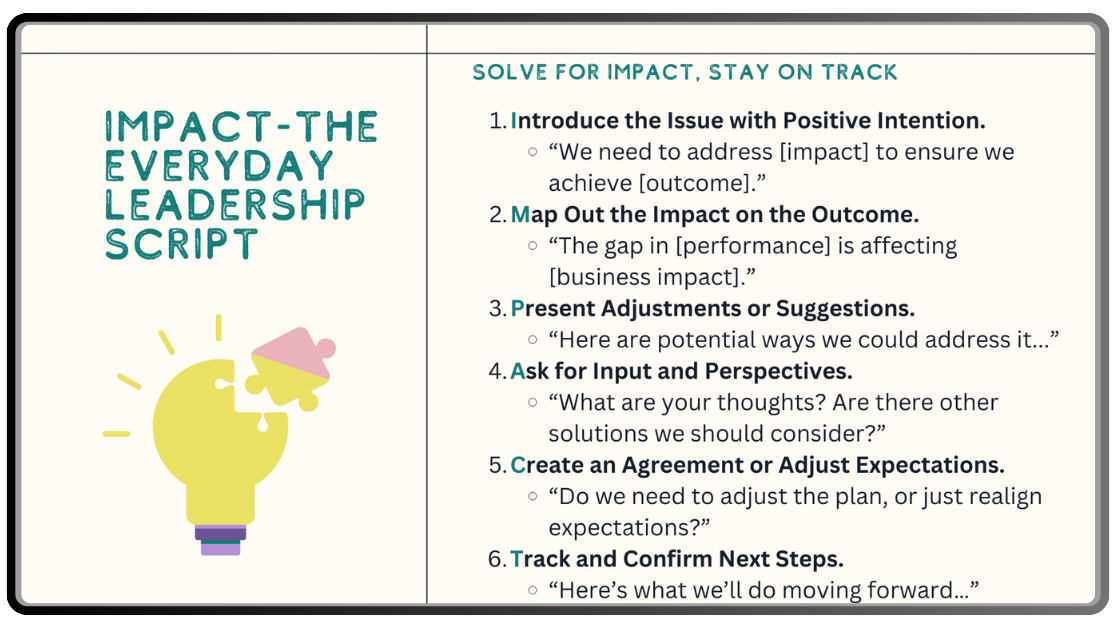
📥 Right click the above image to save and print.
Related Podcast:
Leadership With a Twist Podcast
Related Articles:
Stop Being Swept by the Tide: How Intentional Agreements Transform Your Leadership in 2026
Growth Mindset: Practical Steps for Evolving Your Business